

Table of Contents
Simone Veil: From Auschwitz to the Law That Changed France
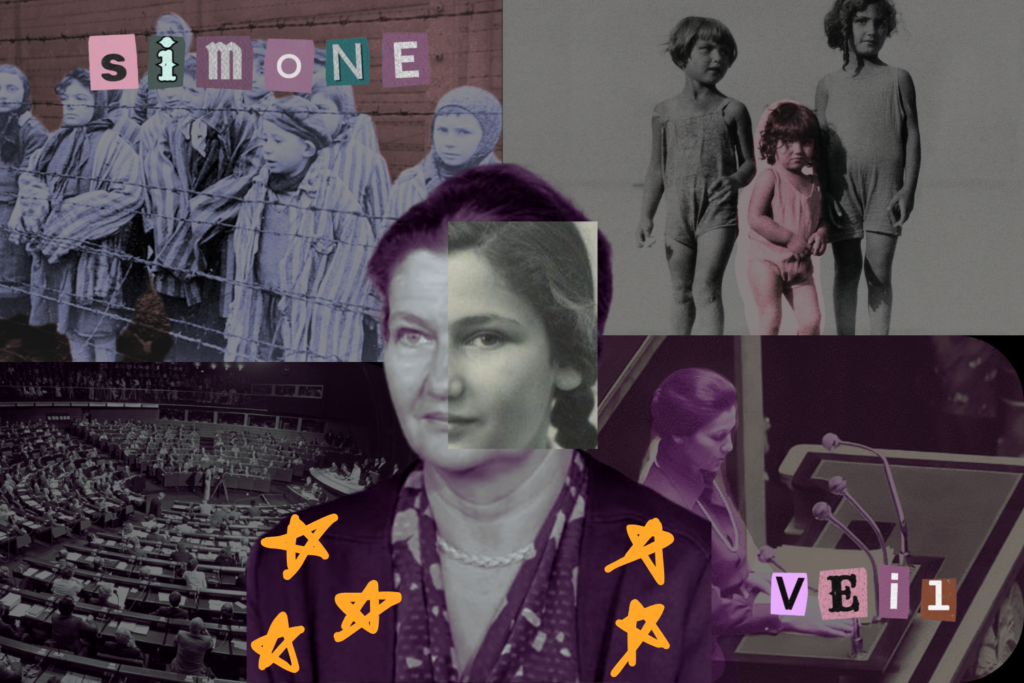
On Holocaust Remembrance Day, it feels especially important to talk about figures whose lives sit at the intersection of memory, law, and human dignity. Simone Veil is often remembered for the law that bears her name, but before she was a minister, a jurist, or a European leader, she was a Jewish teenager deported to Auschwitz.
Her life raises a question that is deeply legal as well as moral: What does justice look like after absolute injustice?
Early Life and Deportation
Simone Veil was born Simone Jacob in 1927 in Nice, into an assimilated, non-practising Jewish family. Her parents believed strongly in education, reason, and the French Republic. That faith would later be broken by the state that failed to protect them.
After Germany invaded France in 1940, the Vichy regime collaborated with Nazi authorities. Nice initially fell under Italian occupation, which allowed Simone’s family to avoid deportation for a time. As arrests intensified, the family split up and lived under false identities. At just sixteen, Simone continued studying and passed her baccalauréat under her real name in March 1944. The next day, she was arrested by the Gestapo. Her mother and sister were arrested the same day.
Simone, her mother, and one of her sisters were deported to Auschwitz-Birkenau. Her father and brother were deported to the Baltic states and were never seen again. Another sister, Denise, was deported to Ravensbrück and survived. Simone and Denise were able to reunite after the war.
Survival of the Camps
At Auschwitz, Simone avoided immediate death by lying about her age and claiming she was over eighteen, thus avoiding the gas chambers. She endured forced labour, hunger, illness, and the constant presence of death. Her mother died shortly before liberation. Simone survived until the camp was liberated in April 1945.
What matters is not only that she survived, but how she understood survival. Simone Veil never treated memory as something static or symbolic. For her, remembrance created responsibility. What had happened imposed an obligation to act differently, to legislate differently, and to protect differently.
Law as a Response to Injustice
After the war, Simone Veil studied law in Paris. She entered the Ministry of Justice and worked within the penitentiary administration, where she focused on improving conditions for women in prison – something which had long flown under the patriarchal radar of the justice system. Later, as Director of Civil Affairs, she played a key role in strengthening women’s legal rights, including shared parental authority and adoption rights.
Throughout her career, law was not abstract. It was practical, corrective, and rooted in lived experience. The legal system had failed her once. She refused to let it fail others as easily.
The Veil Law and the Legalisation of Abortion
In 1974, Simone Veil became Minister of Health. One year later, she defended what would become one of the most significant pieces of social legislation in modern French history: the law legalising abortion, adopted on 17 January 1975.
Legally, the Veil Law marked a fundamental shift in how the French state approached reproductive autonomy. Before 1975, abortion was a criminal offence. Women were prosecuted, imprisoned, and in some cases died as a result of unsafe procedures. The law reframed abortion as a matter of public health and legal protection rather than moral punishment.
What made the law particularly significant was its structure. It legalised abortion within a regulated framework, emphasising medical oversight and informed consent. This approach allowed the state to recognise women’s autonomy while also ensuring legal certainty for doctors. It moved abortion out of the criminal courts and into the healthcare system.
The parliamentary debates were brutal. Simone Veil faced personal, misogynistic, and antisemitic attacks, including references to the concentration camps she had survived. Yet her legal argument remained measured and precise. She did not argue ideology. She argued necessity, dignity, and reality. She spoke about women who suffered in silence and about a legal system that punished vulnerability instead of protecting it.
The impact of the Veil Law went far beyond abortion itself. It affirmed that bodily autonomy could be recognised within a legal framework. It showed that the law could evolve without collapsing. It also set a precedent for future rights-based reforms in France and influenced broader European conversations on reproductive rights.
Perhaps most powerfully, the law demonstrated that someone who had experienced the most extreme form of state control over bodies could stand in parliament and argue that the state should know when to step back.
Europe, Memory, and Constitutional Law
Simone Veil’s commitment to justice extended beyond France. In 1979, she became the first woman elected President of the European Parliament. For her, European cooperation was not bureaucratic. It was a safeguard against repetition.
Later, she served on France’s Constitutional Council, helping protect fundamental rights at the highest level of the legal system. A survivor of deportation participating in constitutional review carries an unavoidable symbolism – it reflects the idea that memory belongs inside the institutions that frame our futures, not just museums.
Why Remembering Simone Veil Still Matters
Remembering Simone Veil on Holocaust Remembrance Day is not simply about remembering her incredible trajectory. It is about understanding the significance of her willpower and commitment to ending the cycle which tore apart her family and millions more. She must be remembered as someone dedicated to emphasising what law can become when it forgets human dignity and what it can achieve when it remembers it.
Her life shows that rights are not inevitable. They are built by people who understand what happens when they disappear. The Holocaust was not only a moral failure but a legal one. Laws were used, twisted, and enforced to exclude and destroy.Simone Veil responded by insisting on law as protection rather than punishment, on memory as responsibility rather than resentment, and on justice as something that must be actively defended.
Remembering her is a choice to stay alert to how power operates, whose bodies are regulated, and whose voices are dismissed. That is why her legacy still matters, and why it belongs in conversations about law today, in a world of increasing uncertainty and lack of choice.
“We must not wish for the disappearance of our troubles but for the grace to transform them.”