

Table of Contents
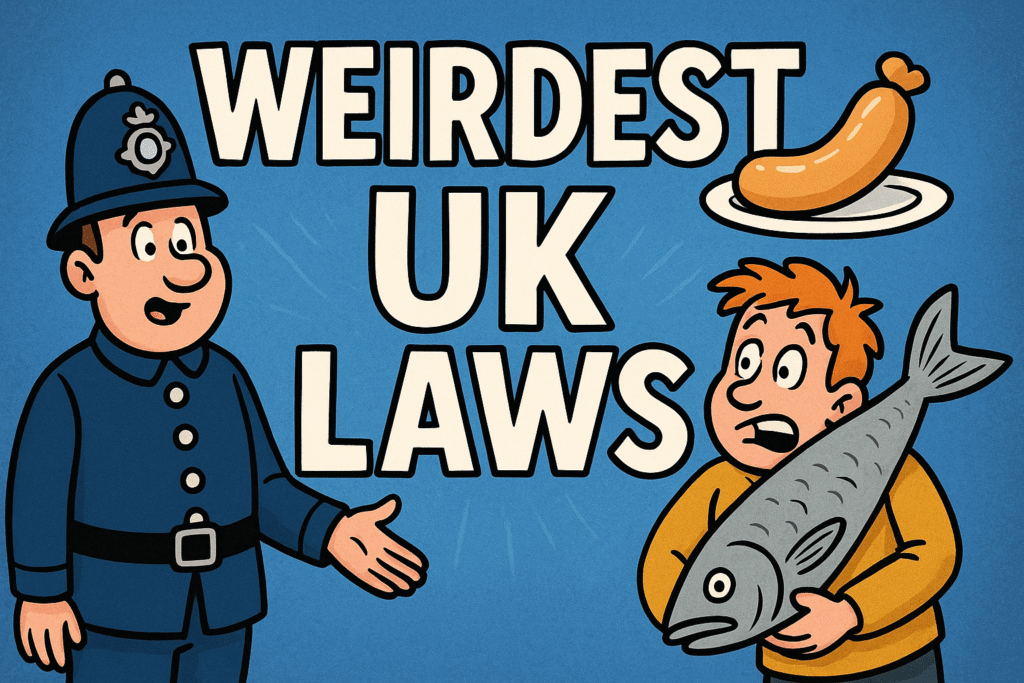
Weird UK laws have a way of catching the imagination, rules so specific or unusual that they sound more like stories than actual legislation. From suspicious fish-holding to banning carpet-beating in the streets, these laws once served serious purposes, but today they read like curious glimpses into another time. Let’s explore some of the UK’s most strangely specific laws.
1. Fishily Holding Salmon is a No (Section 32, The Salmon Act 1986)
It sounds like the set-up to a comedy sketch, but Section 32 of the Salmon Act 1986 really does make it an offence to “handle salmon in suspicious circumstances.” In reality, it was designed to crack down on poaching and the illegal sale of fish, especially when salmon populations were at risk. But the law’s vague wording means you could technically look like a criminal just for standing on a street corner holding a large salmon while looking around nervously. It’s unlikely you’d actually be arrested for this, but you might make the local paper.
2. No Beating Dusty Rugs in the Street, People! (Section 60, Metropolitan Police Act, 1839)
Back in the sooty, smog-filled streets of Victorian London, the last thing anyone wanted was an extra cloud of dust in their face. So, Section 60 of the Metropolitan Police Act 1839 made it illegal to beat or shake carpets, rugs, or mats in the street. The one small mercy? Doormats were allowed to be beaten, but only before 8 a.m., presumably so neighbours could enjoy the fresh (well, “Victorian fresh”) morning air without sneezing themselves to death. This was part of a much bigger push to “civilise” London’s public spaces, though by modern standards it sounds charmingly petty.
3. No High Rollers, Just High Shelves (Libraries Offences Act 1898)
When you think of crime in a library, you might imagine someone not returning a book, but the Libraries Offences Act 1898 was far more ambitious. It made it illegal to gamble, use obscene language, or behave in a disorderly way in a public library. No card games in the reading room, no betting on horse races between the stacks, and certainly no foul-mouthed debates over Shakespeare. The goal was to keep libraries peaceful, respectable places for learning, but the mental image of a librarian breaking up a heated poker match between dusty shelves is almost worth breaking the rule for.
4. Moo-ving Violation (Metropolitan Streets Act)
If you were hoping to take your herd of cattle for a scenic trot through London, the Metropolitan Streets Act would put an end to that plan. The law made it an offence to drive cattle through the streets without permission, an issue that was once a genuine urban problem. Before cars, animals were a common way to transport goods, but they often clogged up roads, startled pedestrians, and caused all sorts of “organic” mess. Today, it’s mostly a charming historical footnote, though the law technically still stands, so your cow parade would need official clearance.
5. Dead Wrong
In the past, certain local bylaws in the UK made it illegal to loiter or hang around in churchyards after a funeral had finished. The idea was to stop troublemakers, gossipers, and nosy neighbours from turning solemn occasions into social events. While the exact penalties varied from place to place, the underlying message was clear: pay your respects and then move along. It paints an oddly strict picture of social etiquette. Imagine a gravedigger politely but firmly telling you, “That’s all the free mourning you get for today!”
Most of these weird UK laws aren’t actively enforced today, but they remain part of Britain’s legal history and a humorous reminder that the law can sometimes be as peculiar as the society it regulates. Some were created to maintain public order, others reflect very particular moments in history, and a few just seem absurd now. Either way, they make for fascinating and often amusing glimpses into the past.